By Vuyisile Dube
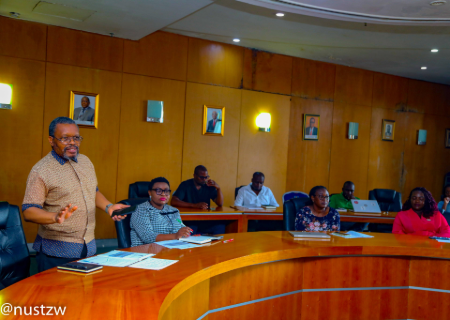
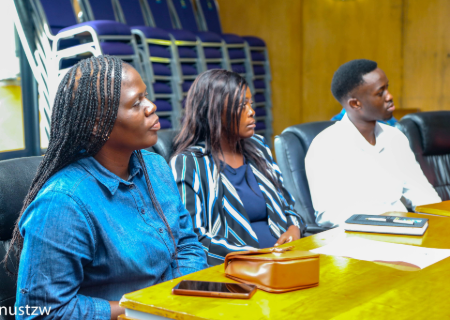
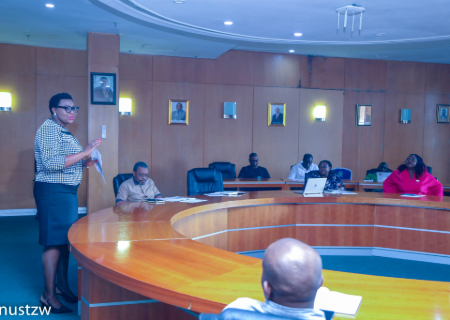
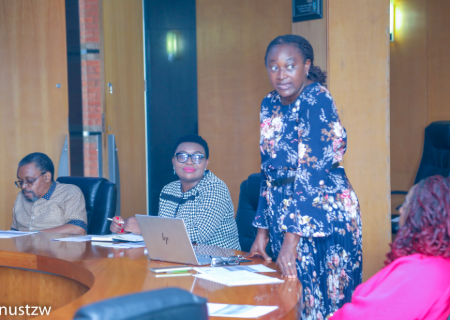
The National University of Science and Technology (NUST) on Thursday morning welcomed home five students who participated in the prestigious Erasmus Mundus Student Mobility Programme at Uppsala University in Sweden. The homecoming event, held in the Council Chambers in Bulawayo from 10am to 11am, brought together university leadership, internationalisation officials and students to celebrate the academic and cultural exchange.
The programme, led locally by the Research and Internationalisation Office, aims to broaden global exposure for Zimbabwean students by immersing them in world-class research environments and diverse academic systems.
Representing the cohort were Mr A. Nyoni, Mr C. Musandipa and Ms. H. V. Kaitano, who shared reflections on their academic journeys abroad and the impact of studying in Europe. The initiative was spearheaded and coordinated by Professor Thembekile Ncube, Director of the Research and Internationalisation Office, with the full support of NUST’s leadership. Among those in attendance was Vice Chancellor Professor M. E. Dlodlo, whose presence underscored the institution’s commitment to global engagement and student advancement.
In their testimonies, the returning students highlighted not only academic growth but personal transformation. Nyoni spoke candidly about confronting stereotypes and discovering a welcoming academic environment. “As an African going to Europe sometimes you hear people say you will be segregated. I don’t want to lie, I was received very well,” he said. He praised the modern systems at Uppsala, including its structured student networks and advanced learning facilities, describing the exposure as eye-opening and empowering.
Kaitano detailed her academic immersion across four departments, including groundbreaking research in lithium-ion battery technology. “I did my courses in four different departments. The first one was in the department of chemistry, in a battery centre. They are doing research on lithium ion batteries and I want to say I learnt a lot from that department because my research is on lithium ion batteries as well,” she said.
She continued, emphasising how access to state-of-the-art laboratories and equipment enhanced her research capacity. “Their equipment is state of the art. The lab is state of the art. You get the opportunity to work with different types of equipment.”
Welcoming the students, Vice Chancellor Professor Dlodlo reflected on the broader importance of global exposure in shaping future leaders. “When you grow up in one area, in one part of the globe and never go anywhere else, you think that that is the way the world is,” he said, noting that cross-cultural learning fosters adaptability.
He warmly added, “Welcome back to the land of ubuntu. We are proud of what you have achieved through the Erasmus exchange programme and we are proud of the maturity and the exposure we see that you have now brought back to this campus.”
Challenging the students to translate their international experience into institutional growth, the Vice Chancellor posed a call to action. “Today I want to challenge you even further. You have experienced systems that trust young people with responsibility. Now the question is ‘how will you use that exposure to build NUST?’”
The event reflected more than a ceremonial welcome. It demonstrated NUST’s strategic commitment to internationalisation, research excellence and student empowerment. Through the leadership of Professor Ncube and the Research and Internationalisation Office, the Erasmus Mundus Student Mobility Programme continues to position NUST students as globally competitive scholars while reinforcing the university’s reputation as a hub of academic ambition in Zimbabwe.