
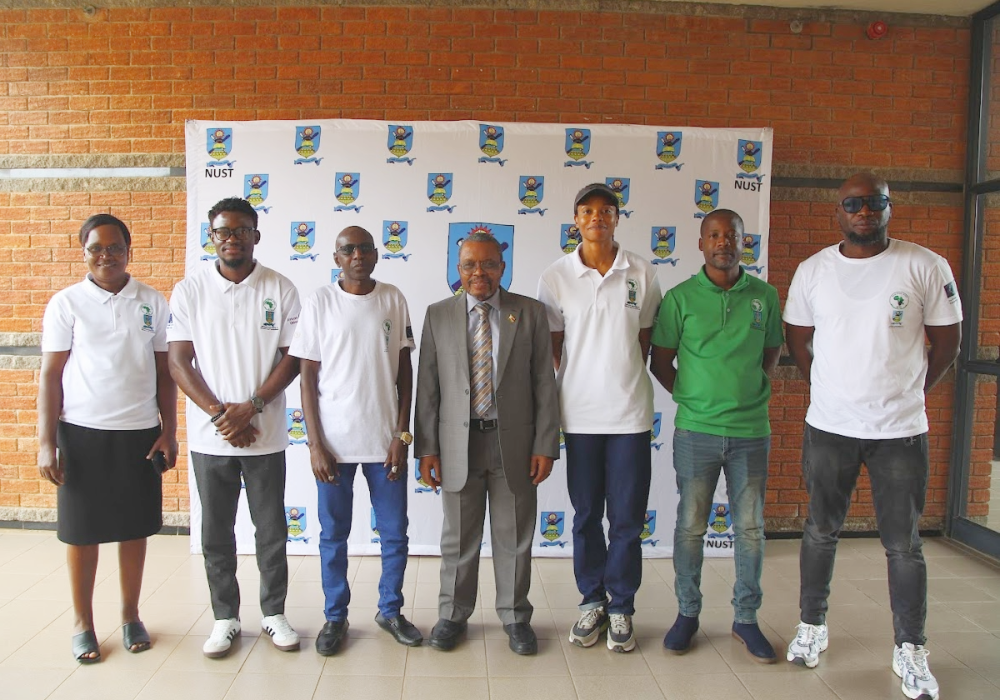
A group of international students currently on an exchange visit under the Grow Green Africa (Gr2A) project this week paid a courtesy call on NUST Vice-Chancellor, Professor Mqhele Dlodlo, cementing the University’s status as a premier regional destination for research-driven education.
The young scholars and now international researchers, Stephen Tobigah Maldina, Chukwu Success, Romeo Ngenda Simasiku, Hazael Uzi Phiri, and Elh Maman Garba Ibrahim, represent nations including Nigeria, Namibia, Zambia, and Niger, are integrated into the Department of Informatics and Analytics in the Faculty of Applied Sciences, where they are developing green computing solutions to tackle Africa’s urgent agricultural and climate challenges.
The visit highlights how NUST is successfully using high-impact, EU-funded research initiatives to attract elite scholars from across the continent, moving beyond traditional recruitment to a model based on collaborative innovation. During the meeting, Professor Dlodlo emphasised that the presence of these scientists is a direct result of NUST’s commitment to an internationalisation agenda, noting that the university is not merely hosting students but cultivating "ambassadors of a collective commitment to a sustainable future."
He said, “You are not just students; you are ambassadors of a collective commitment to a sustainable future
for our continent,” He added,“We are training a new generation of scholars with the green computing skills needed to protect our environment and drive Africa’s sustainable development.” Professor Dlodlo also encouraged the students to embrace NUST’s culture of innovation and critical thinking.
“Embrace the spirit of thinking in other terms, challenge the status quo, and use your knowledge to build solutions that will shape Africa’s future,” he said.
Project Coordinator, Dr S. Moyo, commended the collaborative effort within the university and highlighted the importance of innovation-driven outcomes from the programme.
“As we move into the second phase of the project, our focus will shift towards short-termenrolments while strengthening the support systems that have made this initiative possible. We look forward to seeing innovative, practical solutions from our scholar’s solutions that will not only advance computing, but also safeguard agriculture, food security, and environmental sustainability across the region,” she said.
The attraction for these international students lies in the tangible impact of NUST’s research infrastructure. Success Chukwu, a scholar from Nigeria, remarked that the university’s academic approach is uniquely engaging and practical, allowing her to gain valuable skills that translate directly to real-world challenges.
“I am excited to be in Zimbabwe and I am really looking forward to learning both the NUST culture and the Zimbabwean culture as a whole. So far, my stay at NUST has been amazing. Academically, the programme is very engaging and practical, and I am gaining valuable skills that will help me apply green computing solutions to real-world challenges.”
By positioning itself as the technical lead in the Intra-Africa Academic Mobility Scheme, NUST is creating a magnetic environment for scholars who seek to challenge the status quo and build practical, environment-saving technologies.
This sentiment underscores NUST’s strategy of using the Gr2A project, which supports 10 PhDs, 35 Master’s students, and 8 trainees, as a flagship to prove that Zimbabwean institutions can lead sophisticated, multi-national academic networks involving partners from Finland to South Africa.
Professor T. Ncube, the Director of the Research and Internationalisation Office at NUST, challenged the cohort of Grow Green Africa (Gr2A) scholars to bridge the gap between theoretical computing and practical, climate-smart solutions to address food security and environmental stressors across the SADC region.
"I view this initiative as a transformative step for NUST as we spearhead regional efforts in climate resilience through Green Computing. Many researchers appreciate the role of computing systems in enhancing productivity, but only a few appreciate the damage caused by computing solutions on the environment,” she said.
She added, "Whether you are exploring edge-computing and AI optimization techniques, or the role of Green AI in predicting crop yield, your mandate is to turn data into peer-reviewed excellence. Let us aim at engineering the digital infrastructure required for a net-zero, climate-resilient Africa."
As the project moves into its second phase, NUST is doubling down on this research-centric recruitment model. Dr. Moyo highlighted that the focus is now shifting toward strengthening the support systems and short-term enrollments that have made the university a competitive hub for international exchange.
Through its Research and Internationalisation office, NUST is fostering an environment where innovation-driven outcomes are the priority, placing itself at the forefront of international education, ensuring that the next generation of African scientists views Bulawayo as a critical center for global knowledge exchange.