
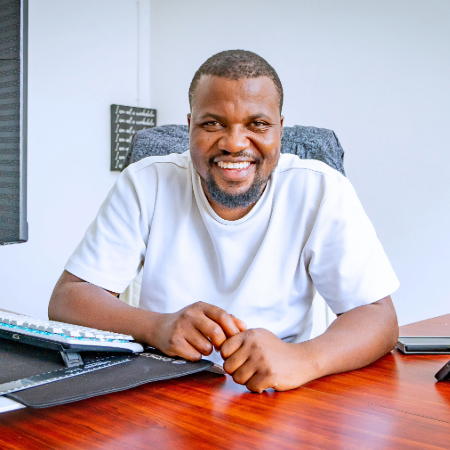
Mbuyiseli Ncube left NUST determined to understand engineering from the ground up, not from a textbook. Today, as founder of Ncube Consults Civil and Structural Engineers, he is delivering landmark projects across Zimbabwe while pushing alumni and industry toward a closer, more practical partnership with his alma mater.
From lecture theatres at the National University of Science and Technology (NUST) to leading complex engineering projects reshaping Zimbabwe's built environment, Mbuyiseli Ncube has built a career defined by technical excellence, innovation and an unwavering belief in local talent. As Founder and Managing Director of Ncube Consults Civil and Structural Engineers, he leads a firm committed to delivering world-class civil and structural engineering solutions while nurturing the next generation of engineers.
In conversation with NUST Alumni Relations Manager Makhosi Sibanda (MS), Mbuyiseli Ncube (MN) reflects on the moment that pushed him to start his own consultancy, the lessons NUST taught him by what it left unsaid, and the milestone project that proved his vision could work.
He also makes the case for a closer partnership between alumni, industry and the university, with NUST as a genuine testing ground for Zimbabwean engineering innovation.
MS: What inspired your career in civil and structural engineering, and what motivated you to establish Ncube Consults?
MN: Honestly, my path into engineering felt guided by God. When I initially went to apply at NUST, I happened to bump into one of the lecturers. We got to talking, and he strongly advised me to pursue civil engineering, emphasising the vast opportunities the field had to offer. That chance encounter set my entire career in motion. The motivation to establish Ncube Consults, however, was born out of frustration and a desire to do things differently. It started when I found myself fundamentally disagreeing with certain ideologies at the company I was working for. I began looking for new opportunities and attended several interviews. I was fairly young at the time, but I had gained a lot of intensive, hands-on experience. Because my experience didn't 'match' my age, many of the people interviewing me felt threatened, fearing I would jeopardise their own positions if hired. The turning point happened on my way home from one of those rejections. I was squashed in a crowded bus, reflecting on the situation, and I simply asked myself: Why not open my own firm? I realised I could create an environment to invite and work alongside like-minded, innovative people. Beyond just delivering engineering solutions, I have always been deeply passionate about creating jobs and empowering others and that remains one of the core drivers that gets me out of bed every day to build and grow Ncube Consults.
MS: Which experiences at NUST most shaped your professional path and approach to engineering?
MN: The experiences that shaped me most at NUST actually came from navigating what wasn't taught. During my time there, I realised that the curriculum focused heavily on the 'how' without ever explaining the 'why.' No one explicitly broke down the core purpose of certain courses or how they connected to real-world engineering. You had to discover that relevance entirely on your own. It was a true revelation when it finally clicked for me, and I realised that many students got left behind simply because they never received that foundational context. Having to self-learn and bridge that gap myself fundamentally changed my approach to engineering. Furthermore, as someone who wasn't naturally the loudest or most vocal character in the room, I noticed how easily quiet competence can get overshadowed by louder voices in a university setting. These two realisations became the blueprint for how I operate today. Because I had to figure out the deeper meaning on my own, I have dedicated myself to mentorship. Whenever I train or mentor younger engineers, my primary goal is always to reveal the bigger picture, to help them see the strings controlling the puppet we call engineering. It taught me that real engineering isn't about shouting the loudest or memorising the most; it's about deep, independent comprehension and ensuring that the next generation isn't left to struggle in the dark.
MS: Could you share a milestone or project you're particularly proud of?
MN: One of the most significant milestones in my career to date has been successfully delivering the George Mose group of projects, specifically as part of the wider Donnington portfolio. Overseeing the concurrent engineering works for the factory shell, the main offices, and the abattoir facility was a complex but incredibly rewarding undertaking.
I am particularly proud of these projects because they perfectly highlighted the power of careful planning. Navigating the critical paths, structural requirements, and logistical challenges of multiple distinct facilities at once proved that with meticulous foresight, complex execution can be handled seamlessly.
Beyond the technical success, this portfolio was a major milestone for me personally. Successfully delivering projects of this magnitude significantly increased market trust and validated the faith I had in my vision for the Ncube Consults brand. It was a tangible proof-of-concept that the firm I had always envisioned building was not only capable of handling major industrial developments but could execute them to the highest standard.
MS: What role should NUST alumni play in growing the profession and developing infrastructure in Zimbabwe?
MN: In my view, NUST alumni have a two-fold responsibility: we must actively bridge the knowledge gap for the next generation, and we must turn the university into a true hub for infrastructure innovation.
First, regarding the growth of the profession, there is a massive disconnect between academic theory and practical, on-the-ground experience. Alumni who have gained substantial industry experience need to step up and organize knowledge-sharing platforms—similar to 'TED Talks'—specifically for students and junior engineers. We need to go back and share the unvarnished realities of the industry, explain the 'why' behind the engineering, and bridge that gap so graduates are actually prepared for the consulting and construction world.
Second, when it comes to the development of infrastructure, we need to change how the industry interacts with the university. NUST alumni should be partnering with the institution to introduce new concepts and technologies that can be rigorously tested on campus. If you look at first-world countries, their universities act as the primary testing and R&D hubs for the engineering sector. We should be replicating that model at NUST—bringing real-world infrastructure challenges to the university, collaborating on the research, and developing innovative, homegrown solutions that we can then deploy across the Zimbabwean landscape.
MS: What advice would you give to current NUST engineering students and young graduates?
MN: My single most important piece of advice to current students and young graduates is to deeply meditate on the NUST motto: 'Think in other terms.' The entire blueprint for your professional growth is hidden right there in those four words.
It is very easy to go through university just cramming to pass exams, but the industry doesn't reward memorization—it rewards solutions. To build a truly impactful career in the built environment, you cannot just accept things at face value. You must 'think in other terms.' That means forcing yourself to understand the 'why' behind the engineering, questioning traditional approaches, and finding innovative ways to solve real problems tailored to the Zimbabwean landscape. If you truly internalize that motto and make it the foundation of your engineering mindset, your potential in this industry will be limitless.
Ncube's story is, at its core, an argument for independent thinking in a profession that often rewards conformity. Fittingly, he returns to NUST's own motto to make his point: think in other terms. For students still finding their footing and alumni weighing their next move, his journey is a reminder that durable careers are built not on what is memorised, but on what is genuinely understood.