
Civil and Water Engineering Class of 2028 Visits Kunzvi Dam
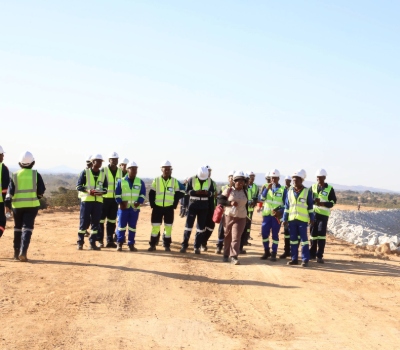
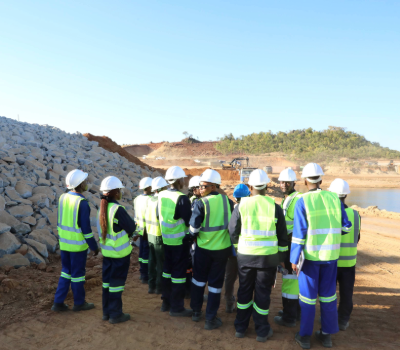
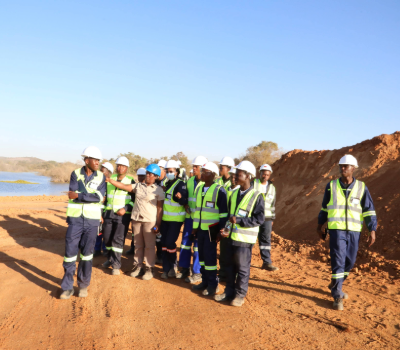
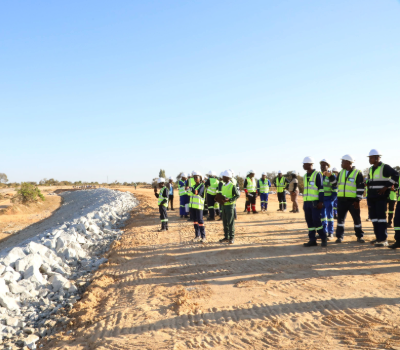
The Civil and Water Engineering Class of 2028 conducted an academic tour of Kunzvi Dam, gaining first-hand exposure to one of Zimbabwe’s most significant contemporary water infrastructure projects. Unlike ageing reservoirs that demand remediation, Kunzvi represents the construction phase of a modern, greenfield water supply system designed to strengthen Harare’s long-term water security. The visit offered students direct insight into large-scale dam engineering from foundation treatment to bulk conveyance.
A primary area of focus was the zoned earth-rock fill embankment. Students observed the construction of the central impervious clay core, compacted in controlled layers to minimise seepage through the dam body. Discussions centred on material selection, moisture conditioning, and compaction control as critical determinants of long-term stability. They also examined the cutoff trench excavated into competent bedrock beneath the embankment, designed to prevent under-seepage and ensure structural integrity at the foundation interface.
Geotechnical engineering featured prominently through the study of curtain grouting operations. Students witnessed how cement slurry is injected into drilled boreholes within fractured bedrock to seal fissures and reduce permeability beneath the dam foundation. This phase highlighted the importance of subsurface investigation, permeability testing, and staged grouting patterns in achieving hydraulic stability.
 |
 |
Attention then shifted to structural components, particularly the D-shaped outlet tunnel. Initially constructed to divert the river during dam construction, the tunnel will ultimately function as a conduit for raw water abstraction and controlled releases. Students analysed its structural lining, hydraulic capacity, and role in both construction sequencing and long-term dam operation.
Pipeline engineering provided another critical learning dimension. The 48 km bulk water pipeline transporting water to Harare utilises Glass Reinforced Polyester material. Students examined why GRP is selected over conventional steel, focusing on its corrosion resistance, reduced weight, and smooth internal surface that minimises friction losses and energy demand during conveyance. The discussion reinforced principles of hydraulic efficiency, lifecycle costing, and material performance in large-diameter pipelines.
The Kunzvi Dam visit positioned the Class of 2028 at the forefront of modern water infrastructure development. It provided a comprehensive understanding of how geotechnical precision, structural design, and hydraulic engineering integrate to deliver resilient, future-oriented water supply systems.
 |
 |