
Civil and Water Engineering Class of 2025 Visits Lake Chivero
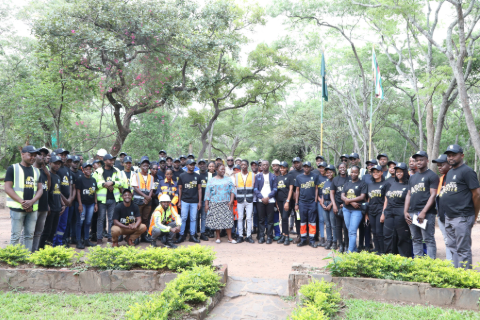
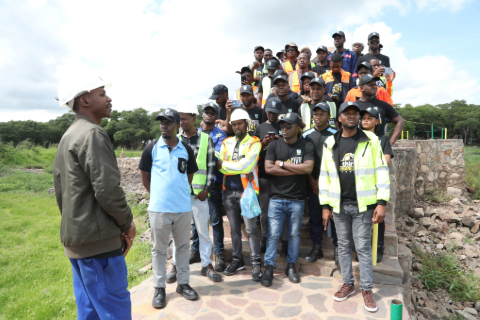
The Civil and Water Engineering Class of 2025 conducted an academic tour of Lake Chivero, Harare’s primary raw water source, gaining direct exposure to the operational realities of urban water supply management. Constructed in 1952, the lake remains the backbone of the city’s water system, yet it operates under significant environmental and hydraulic stress. The visit provided students with a practical understanding of the full urban water cycle, from catchment pressures to treatment challenges.
A major focus was on eutrophication and algae management. Lake Chivero is classified as hypereutrophic due to high nutrient loads largely originating from treated and untreated wastewater entering the reservoir. Students observed how excessive nutrient enrichment drives algal blooms that complicate operations at Morton Jaffray Water Works by clogging filters and increasing chemical demand. This provided a practical demonstration of Biological Oxygen Demand and nutrient cycling, as well as the chemical principles behind algaecide application and process control.
At the treatment works, students walked through the conventional treatment train. They observed coagulation and flocculation processes where alum is dosed to destabilise and aggregate suspended particles. This was followed by sedimentation in large settling tanks, allowing flocs to gravitate out of suspension. Rapid sand filtration then removed remaining fine particles before disinfection and distribution. The experience reinforced the engineering logic behind each stage and the operational adjustments required when raw water quality deteriorates.
Capacity and sustainability were also central themes. Students learned how decades of siltation have reduced the lake’s effective storage volume. Through bathymetric survey techniques, engineers assess sediment accumulation and quantify the loss of dead storage over time. This introduced critical discussions around reservoir lifespan, dredging feasibility, and long-term water security planning.
A comparative hydrological perspective strengthened the learning experience. Students analysed the systemic challenge of sourcing water from a reservoir located downstream of urban discharge. In contrast, they examined the strategic importance of alternative sources such as dams on less-developed catchments. The concept of safe yield was explored in detail, highlighting the maximum sustainable daily abstraction that can be maintained even during prolonged drought conditions without depleting storage.
The Lake Chivero visit provided the Class of 2025 with an unfiltered view of the technical, environmental, and managerial complexities of urban water supply. It reinforced the importance of system thinking in civil and water engineering, where catchment management, treatment efficiency, infrastructure capacity, and sustainability must function as one integrated framework.
 |
 |